

Messages in Monty
CMP and the Message Class
The Cortical Messaging Protocol is defined in the Message class. The output of every SM and LM is an instance of the Message class which makes sure it contains all required information. The required information stored in a Message instance is:
-
location (relative to the body)
-
morphological features: pose_vectors (3x3 orthonormal), pose_fully_defined (bool), on_object (bool)
-
non-morphological features: color, texture, curvature, ... (dict)
-
confidence (in [0, 1])
-
use state (bool)
-
sender id (unique string identifying the sender)
-
sender type (string in ["SM", "LM"])
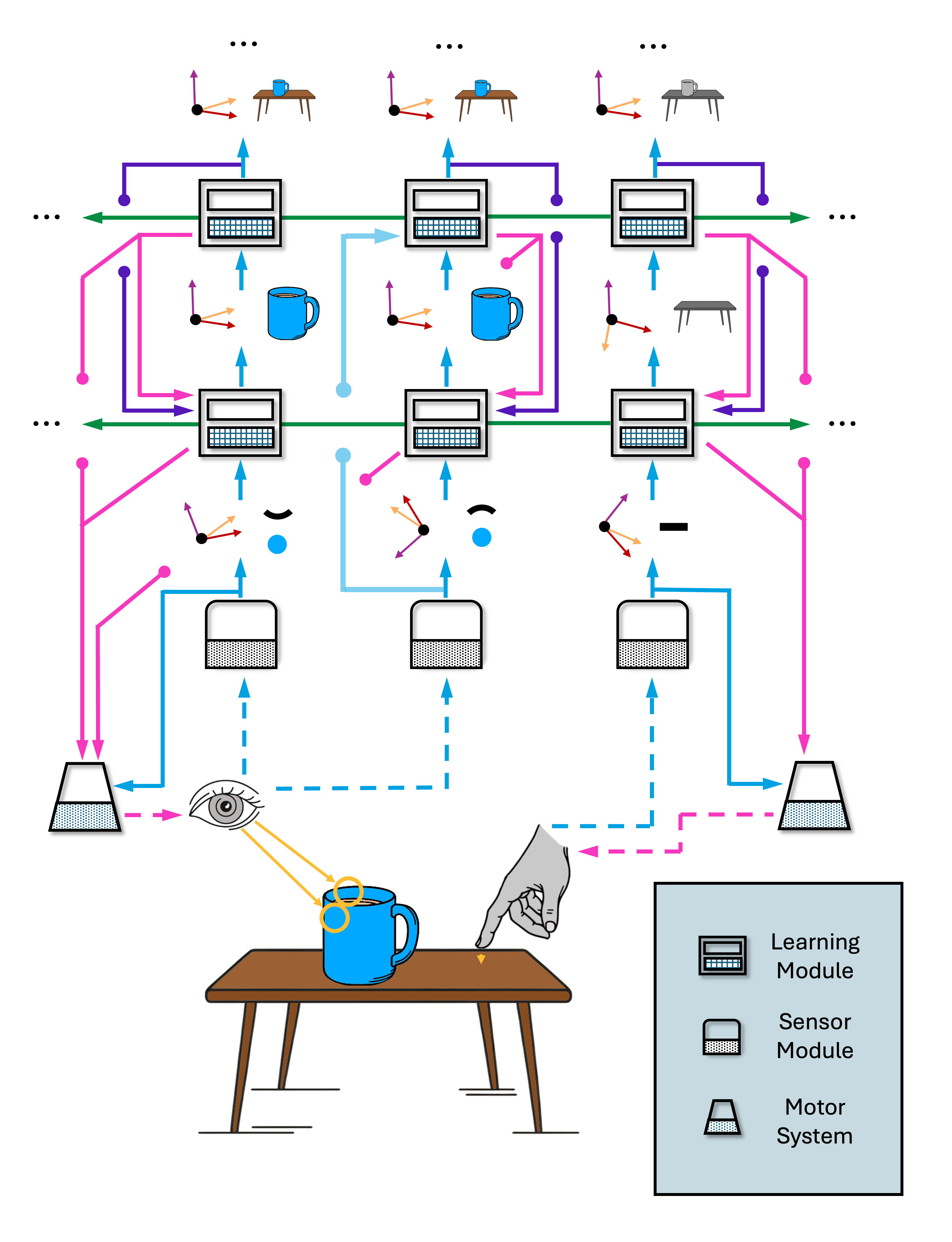
The Message class is quite general and depending who outputs it, it can be interpreted in different ways. As output of the sensor module, it can be seen as a percept. When output by the learning module it can be interpreted as the hypothesized or most likely percept (representing object ID and pose). When it is the motor output of the LM it can be seen as a goal (for instance specifying the desired location and orientation of a sensor or object in the world). Lastly, when sent as lateral votes between LMs we send a list of message class instances which are interpreted as votes (where votes do not contain non-morphological, modality-specific features but only pose information associated with object IDs).
The figure below shows which messages in Monty are CMP compliant.
Help Us Make This Page Better
All our docs are open-source. If something is wrong or unclear, submit a PR to fix it!
Updated 3 months ago